
Italian for your holiday
The phrases you really need in Italy: in restaurants, at the bar, in your hotel, at the station and in the pharmacy. Every phrase comes with pronunciation, plus six rules that let you read almost any Italian word correctly.
Pronunciation in six rules
Italian is pronounced almost exactly as it is written. Learn these six rules and you can read menus and signs correctly first time.
c and g
Soft before e and i: ciao = “chow”, gelato = “jeh-LAH-toh”. Otherwise hard, as in cat and go.
ch and gh
The h makes c and g hard again: chiesa (church) = “KYEH-zah”, spaghetti = “spah-GET-tee”.
gn and gli
gn sounds like the ny in canyon (gnocchi = “NYOK-kee”), gli like the lli in million (biglietto = “beel-YET-toh”).
sc and z
sc before e and i is “sh” (uscita, exit = “oo-SHEE-tah”). z sounds like “ts” or “dz”: pizza = “PEET-tsah”.
Pure vowels, silent h
a, e, i, o, u are always “ah, eh, ee, oh, oo”, short and without the glide of English “day” or “go”. The h is silent: ho (I have) = “oh”.
Double letters
A double letter is held longer. pena is a penalty, penna a pen. Say the consonant twice, as in “bookcase”.
In the pronunciation below, the stressed syllable is in CAPITALS, syllables are joined with “-”, words are separated by spaces and “·” separates two sentences. ah, eh, ee, oh and oo are short, pure vowels; ch as in church, j as in jam, sh as in ship, ts as in cats, dz as in adze, y as in yes. Always roll the r, even before a consonant (parla = “PAR-lah”).
Greetings and being polite
- Buongiorno!bwon-JOR-nohGood morning, hello (until mid-afternoon)
- Buonasera!bwoh-nah-SEH-rahGood evening (from about 4 pm)
- Per favore.pehr fah-VOH-rehPlease (when asking for something)
- Grazie!GRAH-tsyehThank you
- Prego.PREH-gohYou're welcome. Also: What can I get you?
- Mi scusi.mee SKOO-zeeExcuse me (to get someone's attention)
- Non capisco. Può ripetere, per favore?non kah-PEES-koh · pwoh ree-PEH-teh-rehI don't understand. Could you repeat that, please?
- Parla inglese?PAR-lah een-GLEH-zehDo you speak English?
In the restaurant
- Un tavolo per due, per favore.oon TAH-voh-loh pehr DOO-ehA table for two, please.
- Abbiamo prenotato a nome Smith.ahb-BYAH-moh preh-noh-TAH-toh ah NOH-mehWe have a booking under the name Smith.
- Cosa ci consiglia?KOH-zah chee kon-SEEL-yahWhat would you recommend?
- Sono allergico alle noci.SOH-noh ahl-LEHR-jee-koh AHL-leh NOH-cheeI'm allergic to nuts. (A woman says allergica.)
- Un quarto di vino rosso della casa.oon KWAR-toh dee VEE-noh ROHS-sohA quarter litre of the house red.
- Una bottiglia d’acqua naturale / frizzante.bot-TEEL-yah DAHK-kwah nah-too-RAH-leh / freet-TSAHN-tehA bottle of still / sparkling water.
- Il conto, per favore.eel KON-toh pehr fah-VOH-rehThe bill, please.
- Si può pagare con la carta?see PWOH pah-GAH-reh kon lah KAR-tahCan I pay by card?
At the bar
In Italy the bar is the café round the corner. A caffè there is always an espresso.
- Un caffè e un cornetto, per favore.oon kahf-FEH eh oon kor-NET-tohAn espresso and a croissant, please.
- Un caffè macchiato.kahf-FEH mahk-KYAH-tohAn espresso with a dash of milk foam.
- Quanto le devo?KWAHN-toh leh DEH-vohHow much do I owe you?
At the hotel
- Ho una prenotazione a nome Smith.oh OO-nah preh-noh-tah-TSYOH-neh ah NOH-mehI have a reservation under the name Smith.
- A che ora è la colazione?ah keh OH-rah EH lah koh-lah-TSYOH-nehWhat time is breakfast?
- Qual è la password del wifi?kwah-LEH lah PASS-word del WHY-fyWhat's the wifi password?
- Possiamo lasciare le valigie qui?pohs-SYAH-moh lah-SHAH-reh leh vah-LEE-jeh kweeCan we leave our suitcases here?
Getting around: station, bus, directions
- Dov’è la stazione?doh-VEH lah stah-TSYOH-nehWhere is the station?
- Un biglietto per Napoli, andata e ritorno.oon beel-YET-toh pehr NAH-poh-lee · ahn-DAH-tah eh ree-TOR-nohA return ticket to Naples.
- A che ora parte il prossimo treno?ah keh OH-rah PAR-teh eel PROHS-see-moh TREH-nohWhen does the next train leave?
- Questo autobus va in centro?KWEH-stoh OW-toh-boos vah een CHEN-trohDoes this bus go to the centre?
- È lontano?EH lon-TAH-nohIs it far?
Shopping and at the market
- Quanto costa?KWAHN-toh KOH-stahHow much is it?
- Vorrei un etto di prosciutto.vor-RAY oon ET-toh dee proh-SHOOT-tohI'd like 100 grams of ham. (An etto is 100 grams.)
- Mezzo chilo di pomodori, per favore.MED-dzoh KEE-loh dee poh-moh-DOH-reeHalf a kilo of tomatoes, please.
- Posso assaggiare?POHS-soh ahs-sahd-JAH-rehMay I try some?
Pharmacy and doctor
- Dov’è la farmacia più vicina?doh-VEH lah far-mah-CHEE-ah pyoo vee-CHEE-nahWhere is the nearest pharmacy?
- Ho mal di testa / mal di pancia.oh mahl dee TEH-stah / mahl dee PAHN-chahI have a headache / stomach ache.
- Mio figlio ha la febbre.MEE-oh FEEL-yoh ah lah FEB-brehMy son has a temperature. (Daughter: mia figlia)
- Ho bisogno di un medico.oh bee-ZOHN-yoh dee oon MEH-dee-kohI need a doctor.
Emergency number throughout Italy: 112. Bring your GHIC (or an EHIC that is still valid) and travel insurance: the card covers state healthcare, not everything.
Good to know
Coperto on the bill
Many restaurants charge a cover charge per person, the coperto, usually one to three euros. It is normal and not a mistake on the bill.
Tipping
Tipping is not expected. If you were happy, round up or leave a few euros on the table.
Cheaper at the counter
At the bar, an espresso drunk standing up (al banco) often costs less than at a table. Sometimes you pay at the till first and hand your receipt over at the counter.
Validate your ticket
Validate paper tickets for regional trains and buses before you travel, in the machine on the platform or on the bus (convalidare). Without a stamp you risk a fine.
A course for exactly your trip to Italy
A phrasebook can only guess what you're planning. In LingoTrip you tell it: a holiday house on the Amalfi Coast, a trade fair in Milan, a family holiday on Lake Garda. LingoTrip builds a course around exactly those conversations, with audio, speech recognition and spaced review until you leave.
Coming soon to the App Store and Google Play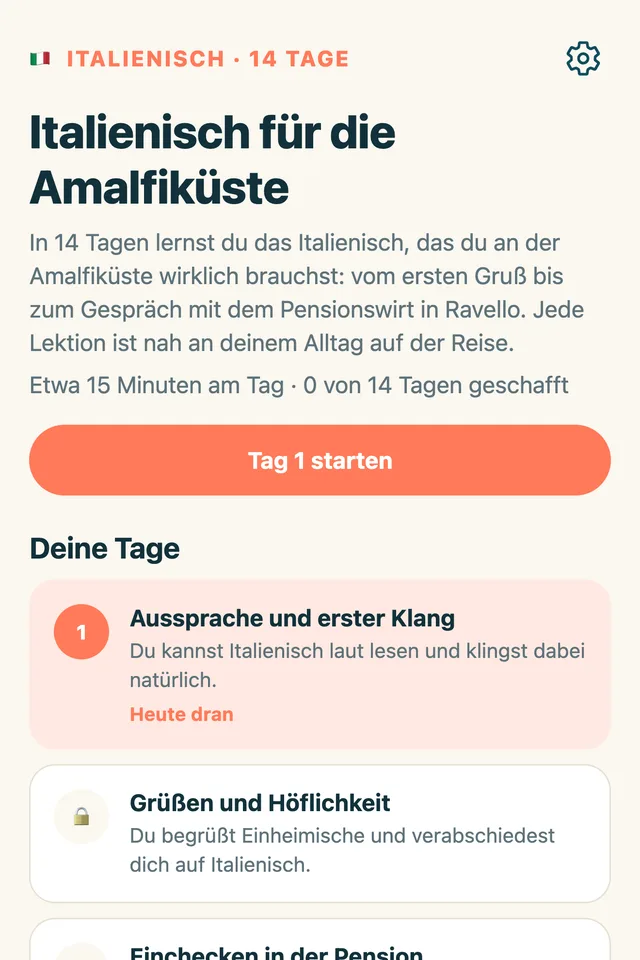
FAQ
How long does it take to learn holiday Italian?
For greetings, ordering, paying and asking the way, one to three weeks at a few minutes a day is enough. You won't hold long conversations yet, but you will manage the usual situations on your own.
Can I get by in Italy with English?
In hotels and tourist areas, usually yes. In small towns, at the market, in the pharmacy or at the doctor's, often not. A few Italian phrases help a lot there.
Do I say “Lei” or “tu”?
English has only “you”, Italian has two. Use Lei, the polite form, with adults you don't know, and tu with friends and children. All phrases on this page use the polite form.
More phrasebooks: Italian for trade fairs · Spanish for your holiday · Spanish at the doctor's with children · Greek for your holiday · Croatian for sailors · Portuguese for moving to Portugal · French for holiday home owners · Danish for your summer house · Dutch for working in the Netherlands · German for business trips · Turkish for meeting your partner's family · Polish for talking with your parent's carer · Swedish for studying in Sweden · Japanese for business meetings · Spanish for house viewings · French for house viewings · Italian for house viewings · Portuguese for house viewings · Danish for house viewings